
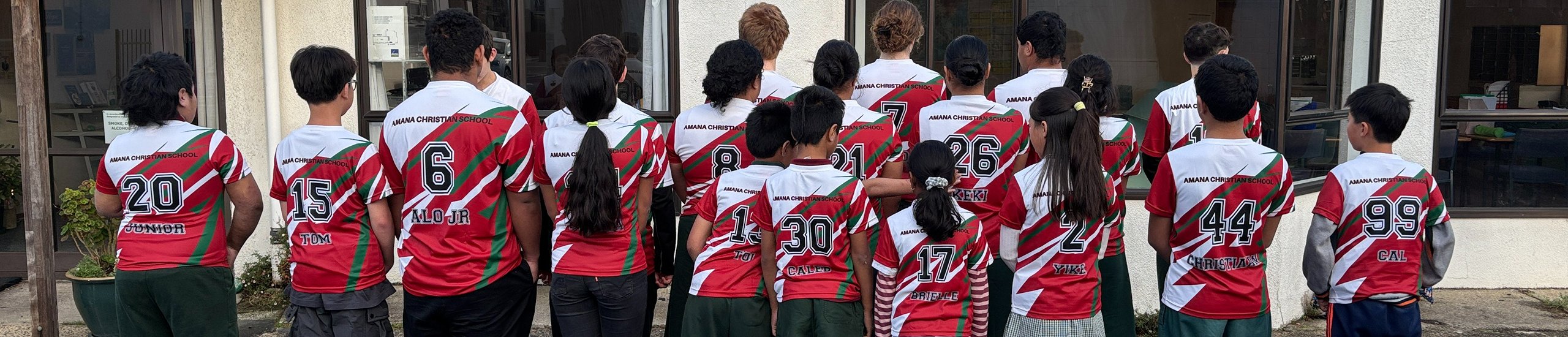
Amana Christian School provides an excellent education standard, using Biblically based curricula infused with Godly character that go beyond simply helping students to achieve a high standard of education. The base of the curriculum is the attributes of God which is taught in a nondenominational way integrating Biblical studies within a child’s life while still learning the basic education courses such as maths, English and the sciences.
What if I’m not a Christian?
You do not have to be a Christian for your child to attend Amana. Education is, however, presented through a Christian world view (see statement of faith and christian education), so your child will learn the Christian message, traditional Judaeo-Christian values, moral framework, presented as being reliably true. This is a key aspect of Amana’s mission.
We recognise that faith in Christ is something personal that each individual is on their own faith journey. The individual’s choice is respected.
Prayer is considered an essential part of school life. Your child will be given the opportunity to participate in prayer, but participation is voluntary.
If you want to understand what being a Christian really means or learn more about Christianity generally please make feel free to contact the School.
Amana Distance Learning uses the Accelerated Christian Education (A.C.E.) curriculum. ACE is an internationally accredited curriculum for university entrance in over 147 countries including New Zealand! It ensures consistent learning. A.C.E. is a Biblically based, educational programme geared to meet the learning needs of individual children. Students are taught to see life from God’s point of view, to take responsibility for their own learning and to walk in Godly wisdom and character. Students are prepared for tomorrow’s world through an ‘extraordinary educational approach, Biblical in its core… while giving them traditional moral values that will last a lifetime.
The strength of the A.C.E. programme is that it provides students with the opportunity to progress at the level of individual ability. Realistic goals are set, achievement is tested and addressed straight away and progress is tangible. Students become self-motivated as they take on ownership of their own learning.
This provides flexibility to progress beyond a specific year level or to gain further grounding in weaker areas of learning. Curriculum approach (from Wikipedia) According to the curriculum section on its website, the A.C.E. “program is individualized and nongraded.” A.C.E states that its “core curriculum is an individualized, Biblically-based, character-building curriculum package”. The material for the classes has an emphasis on reflecting the Christian ideas and principles of the company, including memorising Bible passages and learning creationism.
The A.C.E curriculum is based on a series of workbooks called PACEs (Packets of Accelerated Christian Education). At the beginning of each PACE is an overview of what the child will be learning, a Scripture to memorize, a character trait to strive toward, and a “heads up” on what supplies the student will need.
The programme allows students to advance through high school. The A.C.E curriculum is based on a series of workbooks called PACEs (Packets of Accelerated Christian Education). At the beginning of each PACE is an overview of what the child will be learning, a Scripture to memorize, a character trait to strive toward, and a “heads up” on what supplies the student will need.
Each subject has 12 PACEs per year level. The core subjects of A.C.E. are Mathematics, English, Science, Social Studies, Christian Studies, Word Building (spelling and word usage), Literature & Creative Writing, and Typing (35wpm 98% accuracy). Electives are available also: e.g. Music / Basic & Advanced Art / Nutritional Science / Health / General Business / Auto Mechanics etc. Test keys are published for corresponding PACEs. Additional PACEs apply. Students have the ability to achieve beyond their age/class year.
The average PACE’s a student needs to complete a year is about 60 PACEs (12 per subject x 5). 2 credits are given for one full year subject e.g. Mathematic Overview 1085-1096 (12 PACEs) = 2 credits. 5 full year subjects = 10 credits. For a 1/2 year completed subject like Music 1-6 gains 1 credit.
30 Credits are required for High School Certificate Level 1 which is 90 PACEs per year over 2 years (15 credits per year) or 60 PACEs per year over 3 years (10 credits per year). High school students are expected to do between 25-50 pages of PACE subjects every school day (or for homework). These work margins are set to allow the student to successfully complete the required PACEs in the time allowed.
Certificate of Achievement (with or without endorsements levels) can be achieved for students who are unable to complete the High School Certificate Level 1. The credits needed for a Certificate of Achievement are set for a 1 – 1 1/2 year course (8 credits for C.o.A. or 12 credits for endorsements Level 1&2, and 16 credits for endorsement Level 3).
+ Level 2
* Level 3
Note: Electives are the bottom two sections of the above table (starting with Advanced Art, General Business etc). Although other subjects can be made electives e.g. Literature 8 & 9, Nutritional Science, Health, Accounting etc.
The curriculum at Amana is based on the following principles:
We believe that the following key attributes are important and are taught to the children – speak, listen, read, numerate, sing, and paint with all the ability God has given them:
Parents, please support our local businesses


Visit Website

Call Direct

Send Email
Visit Website
Call Direct
Send Email
Visit Website
Visit Website
